


The marble titans of Turkmenistan
Article by Jens den Boer
In 1991, the Soviet Union officially disbanded. Today, there are 15 post-Soviet states in Europe and Asia. In Europe, we are all familiar with the Baltic states, as well as Ukraine, Belarus, and Moldova. In Asia, there are the Central Asian republics also known as the “Stans.” Bonus points if you can name them all (and spell them correctly). My ‘TOPOS on the road’ will be about, in my opinion, the most interesting, but also the weirdest Stan, Turkmenistan.
Turkmenistan is the southernmost post-Soviet state, bordered by Uzbekistan to the north and Iran to the south. It also borders the Caspian Sea, the world’s largest inland body of water. The country has a population of around seven million people, most of whom live in its largest cities: Türkmenbaşy, Balkanabat, Türkmenabat, Mary, and the capital, Ashgabat. (Zhmuida et al. 2026)
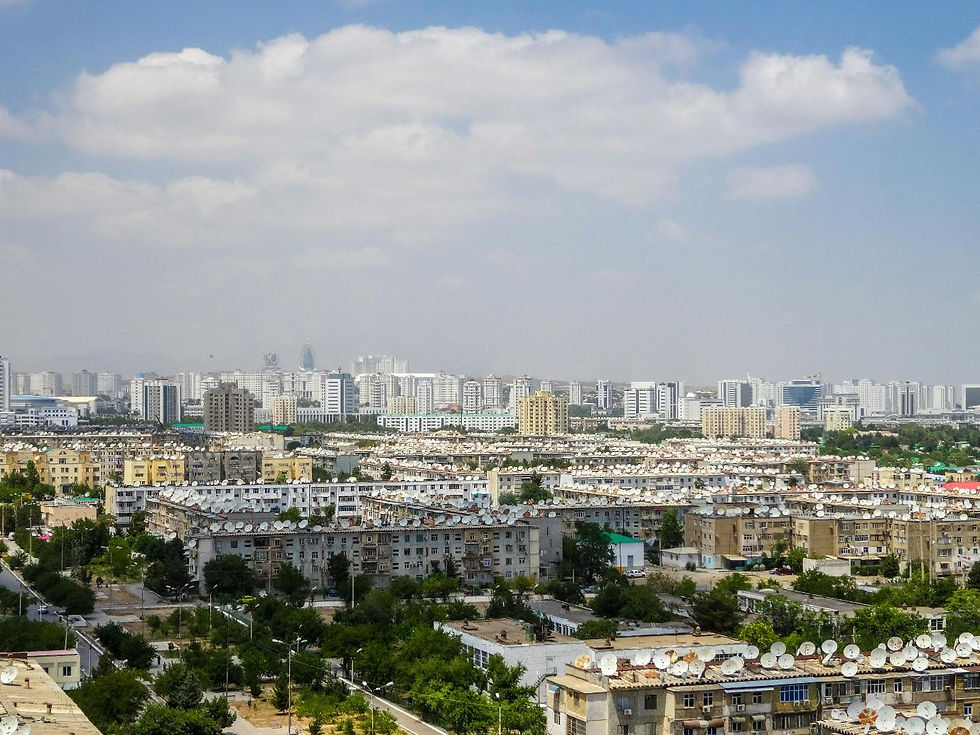
Figure 1 A vibrant aerial view of Ashgabat showcasing modern architecture and residential areas (Kolosov, 2015a)
With TOPOS on the Road, the idea is that the writer shares their experiences of a place they have visited and where they felt a connection to the blog’s current theme. Unfortunately, I was unable to visit Turkmenistan myself. The country is notoriously difficult to enter, with a lengthy and demanding visa process, no online flight bookings, and extremely high costs for the mandatory tour guide that visitors must hire once they manage to gain entry (Christian, 2022). Not strange for a country that many people refer to as the “North Korea of Central Asia.” Therefore, I have decided to take you guys on a virtual tour through the Hermit Kingdom of Turkmenistan where we will see never ending fires, cities of marble and the largest indoor Ferris wheel?
First, I travel deep into the Turkmen desert, a place so isolated that the nearest major sign of civilisation is hundreds of kilometres away. Hidden in this wasteland I find Turkmenistan’s most famous tourist attraction, remnants of a Soviet project gone wrong. In the past, a major part of the Soviet economy relied on gas and oil exploitation from fields in the “Stans,” and in 1971 Soviet geologists were searching for gas deep in the Turkmen desert. During their drilling, they caused a sinkhole to open which caused gas to escape. Engineers wanted to prevent the emission of poisonous gases by igniting them but reportedly underestimated how much there was. It has been burning continuously ever since 1971. The Darvaza gas crater, more commonly known to some as the “Doors to Hell,” has become a popular extreme tourism attraction over the years and many visit Turkmenistan just for this reason (King, z.d.). I can see right over the edge of the crater, blinded by the scorching flames, and I contemplate setting up my tent beside them for the night, but the off-putting smell of gas discourages me…

Figure 2. Darvaza gas crater during night (Esenov, 2015)
Travelling south from the Darvaza gas crater, after endless dessert I finally reach the state’s capital, Ashgabat, a city that emerged in the early 20th century following the Soviet conquest. Like many other former Soviet cities, Ashgabat follows a relatively simple planning scheme, combining linear and radial block layouts typical of cities designed during that period. The layout reflects order and practicality. The city underwent a major rebranding in the 1990s following Turkmenistan’s independence. In an attempt to distinguish itself from its Soviet past, Ashgabat underwent a transformation where it built a ‘new city’ characterised by the extensive use of white marble, gigantomania, as well as the incorporation of national motifs into its buildings, all under the supervision of former President Gurbanguly Berdimuhamedov who was sitting on one of the world’s largest gas reserves. (Comrade Gallery, n.d.) (Kupi, n.d.)

Figure 3 Aerial view of the Wedding Palace and Yyldyz Hotel in Ashgabat, Turkmenistan (Kolosov, 2015b)
Driving into the new city, the first thing I notice is the sheer number of marble-covered buildings and how clean and organized everything looks. Ashgabat holds the world record for the highest density of white marble buildings, earning them a well-deserved first place in the 2013 Guinness Book of World Records. To be fair, I think that the marble works well in a place like Ashgabat. As one official report noted, white marble not only gives buildings an elegant appearance but also reflects sunlight, helping to keep walls cooler in the summer. In winter and during gloomy weather, it supposedly brightens people's moods as well. (Варламов, 2021)

Figure 4. Ashgabat wedding hall during wintertime (hanmuhado0, 2015)
Filling your city with marble kills two birds with one stone: it showcases your wealth, style, and grandeur as a leader, while simultaneously making your city climate-proof for... almost nobody. As I drive further into Ashgabat, I notice the empty streets, vacant buildings, and deserted squares and parks. The only signs of life are usually the occasional police officer keeping a close eye on me and the occasional gardener ensuring that every corner of the new city remains spotless. The new city centre of Ashgabat is effectively the most beautiful well-maintained ghost town. I cannot describe the feelings of emptiness, vastness and eeriness I feel over here.
The city’s vast design and layout make it difficult for me to reach places on foot, as the city centre may only be entered by car, a car that is preferably white or grey and looks spick and span; anything otherwise could result in a hefty fine. (Варламов, 2021)
Driving through the city, I see it scattered with giant statues, monuments, flags, and other grand buildings, each one more impressive than the last. The buildings signify important parts of Turkmen history and are meant to evoke a sense of national pride and power, such as the 118-meter-tall Independence Monument that symbolises Turkmenistan’s independence from the Soviet Union; the Monument to the Constitution of Turkmenistan, a 185-meter-tall structure paying homage to the five tribes of Turkmenistan; the Monument of Neutrality, also known as the “Tripod”, a 75-meter-tall monument signifying Turkmenistan’s neutral stance in world affairs, containing a 12-meter-tall statue of the country’s first president that always rotates to face the sun; and the Alem Cultural and Entertainment Centre, the world’s largest indoor Ferris wheel, which once again earned Turkmenistan a place in the Guinness World Records (Wikipedia contributors, 2026). I marvel at their enormity and absurdity and ask myself why and how.

Figure 5 The Ashgabat Ferris Wheel stands tall against a clear blue sky, showcasing intricate modern architecture. (Русан, 2025)

Figure 6. The Independence Monument in Ashgabat, Turkmenistan, on a cloudy day. (Русан, 2025)
As I conclude my tour of this otherworldly city, I feel insignificant compared to my surroundings. I am here all by myself, surrounded by marble giants that look down on me with their pale white-and-gold gaze. While I may not know their stories, and I come from a place different from theirs, all I can do is admire your significance in silence, titans of Turkmenistan.
Referenties
Варламов, И. (2021, 1 juli). Ashgabat: the city of the living and the city of the dead. Teletype.
Christian, L. (2022, 2 april). Everything you need to know before visiting Turkmenistan | A complete travel guide -
Unusual Traveler. Unusual Traveler. https://www.unusualtraveler.com/visiting-turkmenistan/
Comrade Gallery. (n.d.). Architecture & ambition: Turkmenistan’s bold marble capital.
Esenov, Y. (2015) Door to Hell - Darvaza gas crater. Unsplash.
Hanmuhado (2015). Ashgabat wedding hall during wintertime.
King, H. M. (n.d.). Darvaza gas crater - the door to hell. https://geology.com/oil-and-gas/darvaza-gas-crater/
Kolosov, N. (2015a). A vibrant aerial view of Ashgabat showcasing modern architecture and residential areas.
Kolosov, N. (2015b). Aerial view of the Wedding Palace and Yyldyz Hotel in Ashgabat, Turkmenistan.
Kupi.com. (n.d.). Ashgabat history. https://www.kupi.com/en-ae/explore/turkmenistan/ashgabat/history
Русан, T. (2025). The Ashgabat Ferris Wheel stands tall against a clear blue sky, showcasing intricate modern
Русан, T. (2025). The Independence Monument in Ashgabat, Turkmenistan, on a cloudy day.
Wikipedia bijdrages. (2026, 1 mei). List of tallest structures in Turkmenistan. Wikipedia.
Zhmuida, V.B., Smith, D.R., Allworth, E., Sinor, D., Hambly, G.R. (2026, May 20). Turkmenistan. Encyclopedia Britannica.


Comments