


Our Campus in ‘The Black Hole of Highway Investment’ and Ways to Get Out of It
Updated: Feb 26
Article by Sjoerd Brandsma
Congratulations! In 2025, the 10,000,000th car was registered in the Netherlands (AutoWeek, 2025). Everything that receives attention grows, but in this case that often comes at the expense of Quality-of-Life goals: space for greenery, freedom, health, livable streets, clean air, silence, justice, playing children, and hedgehogs. And yes, I also own a car myself, but I do not automatically need all the privileges that come with it. So why do I get them anyway? Why is ‘accessibility’ about my car, and not about what I really find important?
Looking differently at accessibility
Because we have given a great deal of attention to accessibility for the car-driver, very strange things seem to have become normal. It is unnecessary to blame anyone at WUR, but because we know this campus well, it does form a good starting point to look at ‘accessibility’ in a different way.
For example:
On the fixed walking route for pedestrians between Forum and Campus Plaza, we give priority to parked cars, even on the tactile paving for the visually impaired (fig. 1). Why is the convenience of one car-driver more important than the interests of great numbers of walking campus users?

Figure 1: Parking on the main pedestrian route between Forum and Campus Plaza (photos: Sjoerd Brandsma).
The green trees behind the large glass wall of the auditorium in Omnia are being cut down for the widening of Mansholtlaan, part of the programme ‘BeterBereikbaarWageningen’ (Better-Access-To-Wageningen). The backdrop for diploma ceremonies, debates, and inaugural lectures changes from green into a 7-lane asphalt road (fig. 2). What does this represent?

Figure 2: Trees behind the plenary hall of Omnia are being cut down to make room for the widening of the Mansholtlaan (source: BeterBereikbaarWageningen).
On the Nijenoordallee there is a roadside memorial for a Wageningen student who got killed in 2023. On the road it says: “look to the left and right” (fig. 3). Nothing has changed about the situation. We do not remove the danger, but place the responsibility with vulnerable road users. Is this just? Are we engaging in victim blaming on an important university route?

Figure 3: On Nijenoordallee we focus on measures for cyclists and pedestrians. Measures do not focus on the sources of danger (photo: Sjoerd Brandsma).
In addition, we blame international students for not being able to cycle, for erratically using the road and being a danger in traffic (ResourceMagazine, 2024), but shouldn’t we be striving for streets where you can safely take all the space you need (as an international student, but also as a student who had a couple of beers)?
The parking paradox: with WUR’s ambition to build no additional parking spaces and not to introduce paid parking, while at the same time improving accessibility for car-drivers, additional parking pressure arises and, in the long term, still the necessity for paid parking. How is this going to work? Would it not be better to introduce paid parking immediately, so that extra car lanes at the Mansholtlaan might not even be necessary?
During heat waves, car-drivers drive in the shade, while pedestrians and cyclists have to walk in full sun (fig. 4). If we find health important, can we not reverse this?

Figure 4: Photo during a heat wave. Pedestrians walk in the heat and car-drivers drive in the shade (photo: Sjoerd Brandsma).
Why can’t we solve the abundance of bicycles at the front of Gaia and Lumen (fig. 5). Is it perhaps too difficult for us to give shape to transition and (even temporarily) change a few parking spaces into extra space for bicycle parking?
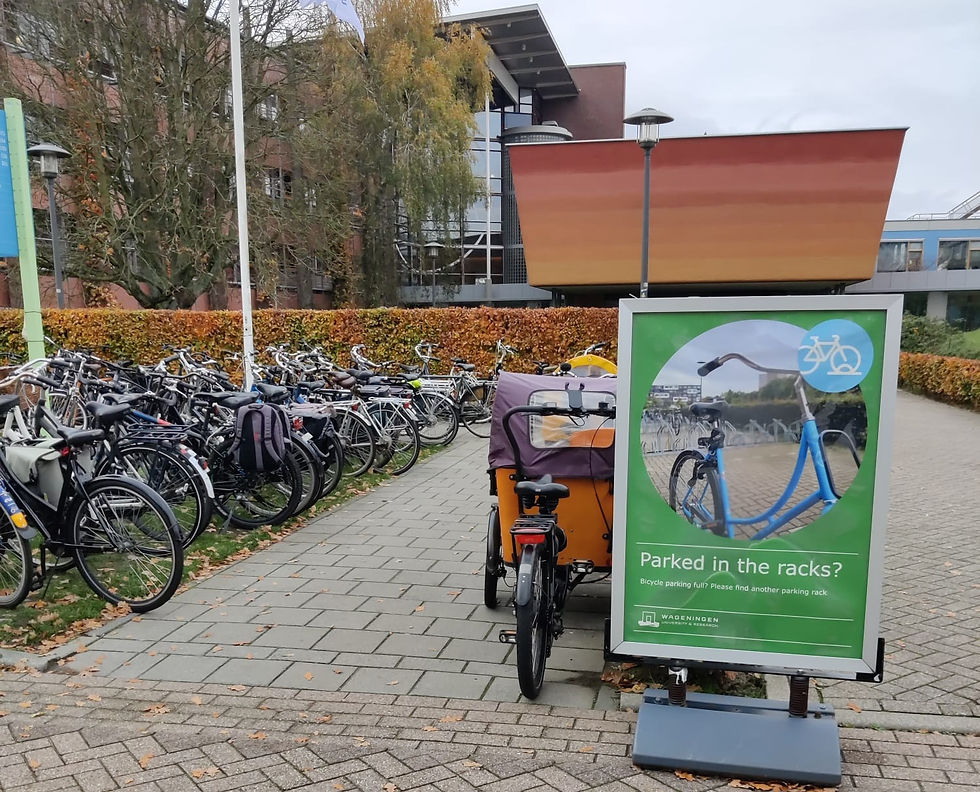
Figure 5: Bicycle popularity in front of Gaia and Lumen. To prevent bicycle parking on the grass, a hedge was recently planted here (photo: Sjoerd Brandsma).
Should we not stop framing the 5 o’clock outbound traffic jam on Droevendaalsesteeg (fig. 6) as a problem to be solved, but instead see it as a feedback loop of the campus or society we are creating?

Figure 6: The daily traffic jam on Droevendaalsesteeg can be framed as a problem to be solved. Or we can see it as a feedback loop of our society (photo: Sjoerd Brandsma).
The car, traffic jams, and accessibility
In Movement (winner of the Brusse Prize – best journalistic book 2021), by Thalia Verkade and Marco te Brömmelstroet (University of Amsterdam), we read how the car has become so central that the number of cars in The Netherlands has been able to grow to 10 million. The dominant position of the car in our cities is in fact quite recent. Less than fifty years ago, streets were places of life, play, and encounter, but with the introduction of the car the traffic engineer increasingly gained a prominent role. By approaching traffic through flow theory and biology, streets changed: roads became ‘arteries’ that were not allowed to ‘clog up’. Complaints about traffic jams were not allowed to exist. Traffic jams became a problem that had to be solved at all costs. Travel time gains and getting quickly from A to B became the most important criteria and decisive in the traffic engineer’s calculation model.

Figure 7: The Black Hole of Highway Investment (source: D.A. Plane, ‘Urban transportation: policy alternatives’. In: Hansen & Giuliano (eds.), The Geography of Urban Transportation (second edition), Guilford Press (1995), p. 439.)
In this way, we became entangled in The Black Hole of Highway Investment (fig. 7). Investment after investment was made to solve traffic jams, and as a result we became increasingly dependent on the car. The BREVER law states that as long as we continue to solve traffic jams and expand infrastructure, average travel time does not decrease (Faber & Huang, 2025). On the contrary: driving becomes easier and more attractive, which leads to buying more cars. It is a self-reinforcing effect. Our cities thus increasingly became an expression of the idea that traffic flow and freedom of movement for the car-driver are central, often resulting in absurd technical spatial claims (fig. 8 & 9). Even cyclists move along ‘bicycle highways’: in the language of the car-driver.

Figure 8: Future entrance to the Campus. In the Plan BeterBereikbaarWageningen of the Province of Gelderland we see the large spatial claim for a 7-lane intersection with waiting areas and traffic lights, replacing the roundabout at Droevendaalsesteeg (source: Province of Gelderland).
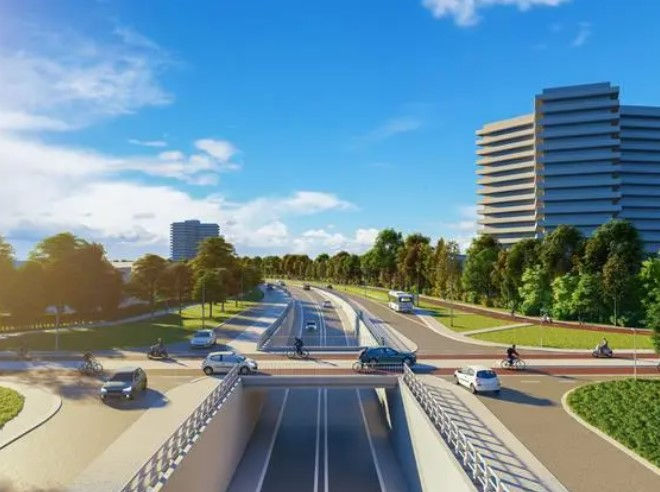
Figure 9: In the Plan BeterBereikbaarWageningen of the Province of Gelderland we see major investments and spatial claims for improving traffic flow: a viaduct with exits and a fly-over for cyclists (source: Province of Gelderland).
Meanwhile, we have become increasingly dependent on the car, logistically and economically. Attempts to improve safety and sustainability do not focus on changing the system, but mainly on the machine itself. Car-drivers drive electric: more sustainable and safer, but in increasingly larger and heavier cars. We feed the car-drivers’ perceived ‘privilege of the fastest’: drive everywhere and park right in front of the door. But what is happening outside the car? And at what cost?
Negotiation outcome
When we prioritize accessibility for the car-drivers, costs are shifted onto society. These should also be named as part of the negotiation outcome. We see the need for enormous financial investments in the construction and maintenance of roads, spatial claims, fragmentation of nature, roadkill, noise pollution, unhealthy air, paving, urban heat, and declining livability. The majority of the space between our buildings—the street—is designed for the car and parking. This displaces almost all other goals of a street. It is also a barrier to realizing our own ‘Wageningen’ Quality-of-Life goals.
But the worst part is this: today, two households will get the message that a partner, parent, or child will never come home again (SWOV, 2025). Dozens of people will suffer injuries today that leave them long-term, or permanently, physically and emotionally impaired. Tomorrow it will happen again, and then again, and again. Perhaps you yourself have once been hit by a car, or you know someone to whom this has happened. If we map this out, are we still talking about accidents, or do we observe a pattern (fig. 10)?

Figure 10: Overview of news reports describing serious crashes, deaths, and injuries in the area around Wageningen. You can also map your own living environment by registering at www.roaddanger.org/maps.
Meanwhile, children have literally lost their space and independence. Every day, 17 children or pupils are involved in a crash, often with a car-driver (NPORadio1, 2017). In residential streets, cars are parked in front of the door, while children do not play in the street but in segregated playgrounds. Parents are afraid and fear for their well-being. School environments get a car drop-off zone, while they should actually be places where children can play and explore carelessly. Out of fear of other people’s cars, parents bring their children by car.
Two accessibility narratives in Wageningen
Fortunately, research shows that the idea of ‘accessibility’ can be decoupled from the car-driver and applied much more broadly (te Brömmelstroet et al., 2022). This is happening more and more often nationally and internationally. Administrators take responsibility, in cities such as Paris, New York, and Amsterdam, but also in smaller cities like Haarlem and Groningen. Wageningen is also at the forefront. In 2025, the municipality of Wageningen explicitly reversed the accessibility narrative as one of the first cities in the Netherlands. In the new Visie Bebouwde Kom, travel time gains were put aside and a radically different perspective was put central: “An 8-year-old child must be able to move through the street safely and independently” (Municipality of Wageningen, 2025). This perspective now forms the guideline for street design and connects the interests of children, older people, greenery, justice, and sustainability. A hopeful start!
But this shift requires courage and boldness from responsible changemakers. Concrete change in neighborhoods requires aldermen, civil servants, planners, and designers to let go of the status quo, dare to experiment, and learn to deal with friction and resistance. This is evident, among other things, from the recent transformation of De Nude (Omroep Gelderland, 2024) and the proposals for transformation of Wageningen’s city center (De Gelderlander, 2025).
While the municipality of Wageningen chooses for a new perspective, we still recognize the traditional car dominant accessibility narrative at the Province of Gelderland and at WUR with the campus. In September 2025, the Campus Vision 2025–2040 was presented (Wageningen University, 2025). It emphasizes the importance of an attractive business climate and excellent accessibility, referring to the Province of Gelderland, which assesses the campus as moderately accessible. In addition to improvements for public transport, cyclists, and pedestrians and the long-term dream of parking at the edges, the university also explicitly chooses better accessibility for car-drivers. It thus supports the provincial plans for a campus that is better accessible by car (BeterBereikbaarWageningen) and advocates a direct connection with Campus West, which also facilitates car traffic. Construction of a new western car entrance has recently started.
These two accessibility narratives show how different institutions make divergent choices and may even interfere with another. An easily accessible campus will make it tempting to still take the car or buy a car and may stand in the way of goals for children. They also show that we can take a position on mobility, but during the mobility debate of Resource Magazine only a handful of people were present (Resource Magazine, 2025). Mobility seems to be overlooked. Interesting, because this means there is something to gain! That is why I think that (planning and design) students and Wageningen researchers should better incorporate accessibility narratives to truly realize their ambitions.
About how we transformed a car-dominant (school) environment – and how you can do that too!
So, suppose we consider ten million cars are enough and want to stop further growth: how could that be done? In Movement, the successful transformation of a car-dominant school into a green, relaxed school environment is described. That is the school of my children, where I worked as a designer, together with the authors of the book, for four years. Those lessons were later elaborated by us in a scientific article (te Brömmelstroet & Brandsma, 2025). From the transformation of this school environment, and broader literature on transitions (think of Seeing Like a State – James Scott, or Thinking in Systems – Donella Meadows), a number of general lessons can be drawn. Even in times of budget cuts, we can do something with minimal resources. It is very instructive and meaningful. You can try this yourself:
Start by listening In our neighborhood and at our school, we asked children, parents, teachers, and local residents about their dreams and what they wanted. The desire for a green, playful environment turned out to be widely shared. That collective desire is often already there, but you first have to ask for it. An articulated dream gives politicians and decision-makers a mandate.
Challenge assumptions In the school environment, 100 parking spaces and a 1,100 m² car drop-off zone were considered necessary based on traffic engineering norms. By questioning the “why” of these norms, space for alternatives emerged. What seems normal is often not logical.
Make change visible with temporary experiments A temporary (green) design showed how the space could also function. Once people see a new reality, they can no longer consider the old one self-evident. That experience cannot be unseen and forgotten.
Involve users, especially children Children adopted trees, built nesting boxes, and helped with maintenance. Their enthusiasm opened doors for parents, teachers, and policymakers to join and become part of the new dream. This is how we grew a community.
Tell the story over and over again Newsletters, signs, conversations, social media: changes need a narrative which is repeated over and over. That is also how we learn. People want to feel seen and heard and be part of a story.
Do not rely on automatic institutional support Without structural institutional ownership, everything slowly shifts back to car use. Physical interventions are not enough; you need institutional partners who dare to take responsibility and continue to enforce the new course.
Start small An experiment does not have to be perfect or complete. Small, temporary interventions can create the idea of a neighborhood where opportunities for change lie and, in the long term, even transform an entire neighborhood.
Vision: the campus as the world’s first campuserf?
What if we approached the campus the way we transformed our school environment? As we listened, experimented, and made temporary changes visible, the university can get to know the campus and its people again. The first question has already been asked (fig. 11): in 2022, a student action group asked campus users for their opinion and dreams on mobility (Resource Magazine, 2022). Nearly 600 people completed the survey, including 29% WUR staff and 59% students. Only 20% support further development of BeterBereikbaarWageningen, while 60% would prefer the plans to be canceled. In addition, nearly 80% believe that the proposed plans do not fit the sustainable character of the university and the city. Many respondents also expressed concerns about consequences for the health of local residents, traffic safety, ecology, and the livability of Wageningen and the campus. Sufficient reason to investigate this further, also to prevent pluralistic ignorance (the phenomenon in which a majority that wants change thinks they are the minority and therefore does not act).

Figure 11: Student protest on mobility (among others by planning and landscape architecture students) in 2022 (photo: Jacco Bontekoe).
A wonderful starting point to challenge assumptions and introduce alternative dreams. Imagine, for example, the world’s first campuserf: a university based upon slow lanes, in which students, researchers, and lecturers can safely and freely wander, stroll, philosophize, and dream about future ideas. Space is slowly and consciously shared between people, bicycles, and sometimes cars. In this way, we create space for pleasant routes and places, for our Quality-of-Life goals, and we reframe accessibility. Also challenge assumptions within yourself. You can already start doing that tomorrow. Do as I do: experience it yourself and cycle between the trees on Droevendaalsesteeg. It is an ordinary road, claimed by the car-driver, but it can also be yours. How does that feel?
After challenging assumptions, we can experiment and test step by step throughout the year what works. Removing danger, creating relaxation, making new routes and pleasant places, trying out temporary installations, and bringing the campus to life. Instead of measuring traffic jams or travel time gains, we can also measure chatting students or smiles (fig. 12). We can take inspiration from TU Delft, where researchers at the Green Village experiment with new futures at their campus. Just like there, we can accept that it may be a bit more experimental and a bit more ‘messy’. On a campus that is too neat we should be worried: no transitions are tested.
Figure 12: One of these objects causes nuisance, stands in our way, and should be removed as soon as possible. The other is a car. Six times, a planter for a pleasant walking route between Forum and Campus Plaza was removed within a day. I experiment with transitions with my students. The making process is educational and fun. Do we count those smiles as well? (photos: left and right by Guy Ackermans; middle by Sjoerd Brandsma).
In response to the parking paradox and stop further growth above 10 million cars, we must work with both the carrot (incentives) and the stick (deterrents) by, for example, experimenting with pricing arrangements and price incentives, including paid parking, linked to time-based rates (fig. 13). This allows us to reduce peak moments and invest revenues in a greener, more livable, and more pleasant campus for everyone.

Figure 13: Effectiveness of measures to reduce car use approached from carrot and stick (source: https://theconversation.com/12-best-ways-to-get-cars-out-of-cities-ranked-by-new-research-180642)
In a Netherlands with 10 million cars, Wageningen does not need to invent a new story: we already have one. Institutional support for translating it into a corresponding mobility narrative appears difficult for now. And yes, we have the most sustainable campus in the world—so why change? Still, we must address this challenge, with minimal resources, especially in times of budget cuts. Attractivity for businesses cannot only be defined in terms of car-accessibility: everywhere, municipalities and governments struggle with the same questions, so the university can join in or lead the way. I believe in the words of Danish urban designer Jan Gehl: “a good city is like a good party: people don’t want to leave early.” On a good campus, you want to stay, not leave early. So do not be afraid of the ‘Hill of Hysteria’ about our relationship with the car (fig. 14). Anyone who knows Wageningen knows: the ‘Wageningse Berg’ is not high. Before you know, you passed it.

Figure 14: The “Hill of Hysteria” (source: https://wbrassociation.org.uk/why-changing-our-environment-is-so-hard/)
Finally. My son had national traffic lessons at primary school, like every Dutch child. They taught him he should walk safely on the right-hand side of the sidewalk. Essentially in the same space as facade gardens (geveltuintjes). But children and greenery do not belong on the margins: they belong at the center. What we teach our children and what we see on campus and in our streets is not self-evident but the result of implicit design choices. These choices must be made explicit. Mobility and accessibility challenges are not technical issues, but normative choices that can also be made differently. If we want to step out of the Black Hole of Highway Investment and take our ambitions around health, inclusivity, justice, and sustainability seriously, this requires responsible changemakers. This also places responsibility to you, as landscape architects and planners, who question the existing situation and show how it can be done differently. Perhaps that change will take another fifty years, but let’s start tomorrow.
Interested in spreading the word? There are unique CAMPUS JAYWALKER bags or shirts available at https://thelabofthought.co/shop/wur-jaywalker (I have no interests here. It is non-profit – revenues go to www.roaddanger.org).
References
AutoWeek (2025). Tien Miljoen Auto's in Nederland. Retrieved from https://www.autoweek.nl/autonieuws/artikel/tien-miljoen-autos-in-nederland/
Brömmelstroet, M., & Brandsma, S. (2025). From Citizen-Led Street Experiments to Transformative Change: A Case Study in Improving School Environments in the Netherlands. Built Environment, 51, 436–457. doi:10.2148/benv.51.3.437
Brömmelstroet, M. t., Mladenović, M. N., Nikolaeva, A., Gaziulusoy, İ., Ferreira, A., Schmidt-Thomé, K., . . . Bergsma, B. (2022). Identifying, nurturing and empowering alternative mobility narratives. Journal of Urban Mobility, 2. doi:10.1016/j.urbmob.2022.100031
De Gelderlander (2025). Ondernemers verontwaardigd over parkeerplannen Wageningen: ‘Onbegrijpelijk besluit’. Retrieved from https://www.gelderlander.nl/wageningen/ondernemers-verontwaardigd-over-parkeerplannen-wageningen-onbegrijpelijk-besluit~a62bf259/
Faber, R., & Huang, A. (2025). De BREVER-wat onder de loep: Een kwart eeuw ontwikkeling in de reistijdbesteding per dag. Kennisinstituut voor Mobiliteitsbeleid
Gemeente Wageningen (2025). Wageningen Duurzaam: Mobiliteit. Retrieved from https://wageningenduurzaam.nl/meer-weten-over/mobiliteit/#:~:text=In%20de%20toekomst%20kunnen%20inwoners,andere%20drempels%20zelf%20boodschappen%20doen.
NPORadio1 (Writer). (2017). Scholieren krijgen vaker ongeluk [Radio]. In: NPO Radio 1.
Omroep Gelderland (2024). Hier worden parkeerplekken opgeofferd voor meer groen en water. Retrieved from https://www.gld.nl/nieuws/8227998/hier-worden-parkeerplekken-opgeofferd-voor-meer-groen-en-water
Resource Magazine. (2022). Enquête over auto-georiënteerde campus mondt uit in nieuw initiatief. Retrieved from https://www.resource-online.nl/index.php/2022/10/31/enquete-over-auto-georienteerde-campus-mondt-uit-in-nieuw-initiatief/
Resource Magazine. (2024). Fietsende international krijgt vaker ongeluk. Retrieved from https://www.resource-online.nl/index.php/2024/10/01/fietsende-international-krijgt-vaker-ongeluk/
SWOV. (2025). CBS-cijfers: 675 verkeersdoden in 2024. Retrieved from https://swov.nl/nl/nieuws/cbs-cijfers-675-verkeersdoden-2024
Wageningen University. (2025). Wageningen Campus presenteert toekomstvisie 2025–2040. Retrieved from https://www.wur.nl/nl/nieuws/wageningen-campus-presenteert-toekomstvisie-2025-2040


Comments