


Nature breathes and the river is alive, and we should listen more to what they have to say
Book review by Tobias Arends

Figure 1: The Mutehekau Shipu (or Magpie River) in Canada. (Peter Holcombe, 2019)
'Life' is a broad concept. Its meaning is pondered throughout life, by every generation. Does its significance change over time? Or is its meaning different to each person? Perhaps there is truth in both. These questions are always asked within the context of an anthropomorphic worldview. It forms the backdrop for all thoughts about the meaning of 'our' existence. As humans—and placed at the top of the worldly food chain by our ancestors—we ask the questions and profoundly seek the answers. 'Life' according to, from, for, and by homo sapiens. But, of course, we share this Earth with many other life forms. Of which new ones are being discovered every year, and unfortunately at least as many are going extinct. A wide range of beings that we seem to understand as poorly as our own psyche.
In the classification of life on Earth, the first distinction is made between prokaryotes (bacteria and archaea), eukaryotes, and viruses. After that the three major kingdoms—all of which are eukaryotes—are addressed: animals, plants, and fungi. These three kingdoms are by no means equally appreciated, and the emancipation of all life on Earth still has a long way to go. Currently, only a select number of animal species are protected by (human) rights and/or laws. Yet a certain group of people is already looking beyond the current classification of 'life.' They ask themselves whether an entity without a cellular structure could still be considered 'life.' In particular: the river.
"Saying that a river is alive is not personifying a river, but expanding and deepening the category of 'life,' and thereby […] 'increasing the imagined scope within which the self operates.'"
In his latest book, Robert Macfarlane asks whether a river is alive. And although the very existence of the book immediately gives away a part of the answer, this suspicion is confirmed in the prologue. A river is alive! The rest of the book describes three excursions to Ecuador, India, and Canada. Accompanied by the guardian angels of these—all endangered—rivers, Macfarlane follows their course from source to sea. On these journeys, the book tells the story of the river's formation, the current threats it faces, and the significant efforts being made to keep the river alive. By giving various experts the floor, the author provides an interesting insight into the ecological and hydrological connections between the river and the land it flows through, and how it provides it with life energy. Hopeful and sorrowful passages alternate, as unfortunately not everyone appreciates this natural beauty.

Figure 2: Large parts of the journey were completed by kayak. (Mac Topchii, n.d.)
To help endangered animal species, they are protected by law, but non-living entities are not automatically granted this right. Yet our rivers are also under great pressure and urgently need our help. By recognizing that rivers are living organisms, they can be designated as legal persons. In 2008, Ecuador was the first country in the world to include 'rights of nature' in its constitution. Since then, anyone can legally advocate for nature on both small and large scales. After this, several other countries recognized rivers as living and legal persons:
New-Zealand: Whanganui river (2014)
Colombia: Atrato river (2017), La Plata & Cauca rivers (2018)
Australia: Yarra river (2017)
United States: Tamaqua Borough river (2006),
Bangladesh: all rivers (2019)
Recognizing rivers as 'living' not only has positive consequences for the protection of the river, but also serves as recognition of the indigenous peoples who have often regarded the river as ‘alive’ for centuries. By declaring that the river is alive, the associated land is returned to the indigenous population that has always lived in harmony with the living river, and its protection is hopefully taken more seriously. And if the rights of nature are threatened, such recognition at least provides avenues for legal defense.
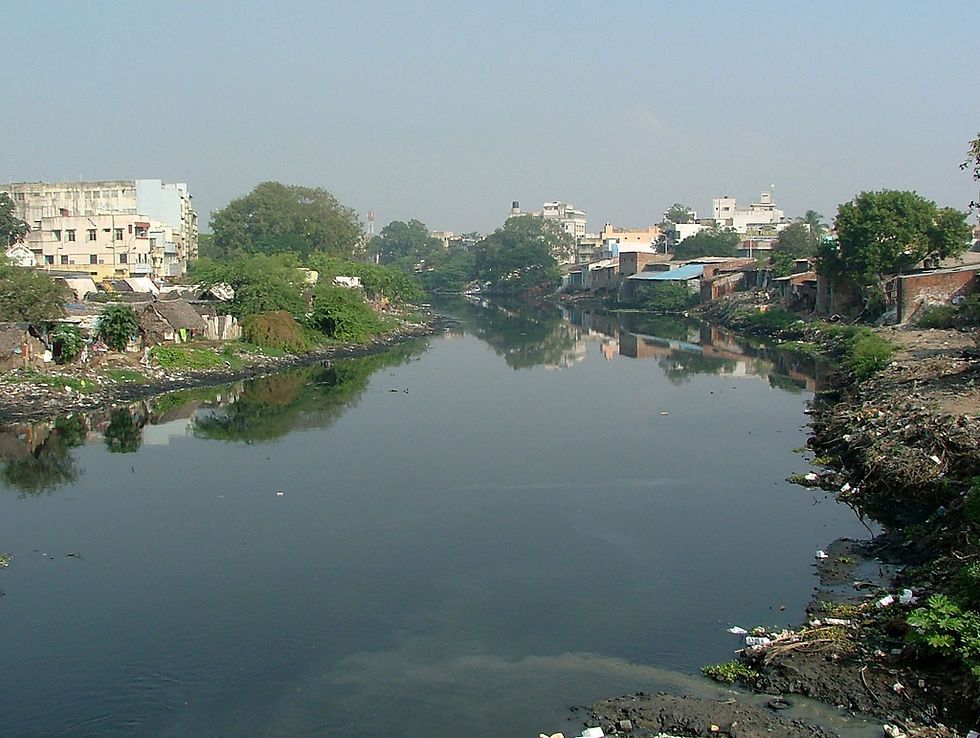
Figure 3: The Cooum River in India, which is heavily polluted. (Peter Fristedt, 2007)
"[…] 'is 'transcendence' the tendency to rise above earthly concerns—such as the weight of your body or the burden of mortality—'incendence' is the tendency to dive into it, to probe its depths and find your way to the core.'"
In order to understand something as vast and elusive as 'the river,' one must completely surrender oneself to it and immerse in the ancient voice that seeps through the mountains, forests, and grasslands. Across the lines drifts an immensely poetic and spiritual power with which Macfarlane takes his reader into the intangible world of the river. According to him, by approaching the river from up close and on equal ground, genuine connection can begin. In a world that has increasingly focused on the grander schemes and the urban individual, the small and undervalued have become far more important. Legally protecting the river has already led to many positive developments, but for a truly sustainable and future-proof symbiotic relationship with nature, we must not lose contact with it, even on the smallest scale. Because to survive the Anthropocene, we so desperately need each other.

Leeft een rivier?
Robert Macfarlane (transl. Nico Groen)
Athenaeum–Polak & Van Gennep
ISBN 9789025316136
416 pages


Comments