


Hedges drive wedges?
Column by Geert Walinga
Hedges might perhaps be one of the most endearing things humanity has ever invented. Green lines in the landscape to keep the sheep in, to mark boundaries, or, increasingly these days, as connecting corridors between fragmented nature patches. The hedge is making a comeback in our profession, promoted as a magnet for biodiversity and as a cooling element. Is the hedge being celebrated again under the banner of nature conservation and greening, or is there something else at play? Is the hedge really as gentle as it seems? It is time to shed light on the dark side of the hedge: the hedge as a means of controlling the landscape.
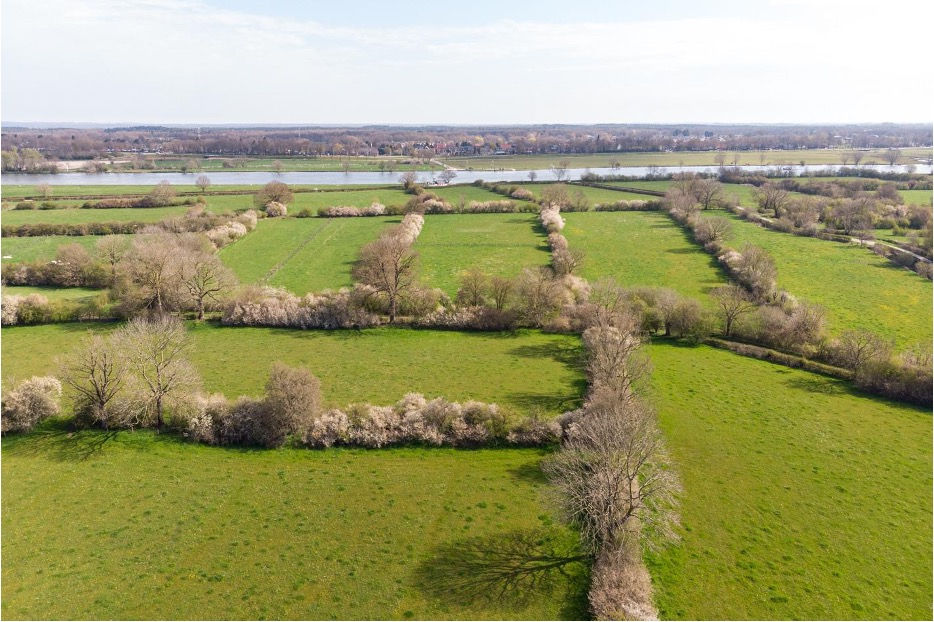
Hedges have existed in Europe since before Roman times. In his Commentarii de Bello Gallico, Julius Caesar described the impenetrable network in what is now Belgium — not as nature, but as an obstacle (Roeleveld & Gielen, 2006). What at first glance appears to be a practical intervention soon proved to be a means of controlling movement and restricting access. Hedges separated plots of land, kept livestock in and wildlife out, and provided coppice wood. But it is precisely in these functions that their power lies: they organise the landscape and make boundaries self-evident. Thus arose a network that divided not only the land, but also its use.
Yet, alongside the ‘landscape hedge’, we also know of another type of hedge. It can be found in palace gardens such as those of Paleis het Loo and Chateau Versailles. It is the well-known Baroque hedge (often made of boxwood, although in most gardens this has probably been replaced by a moth-resistant variety). Clean lines in the landscape as a representation of humanity’s domination over nature. It is here that the hedge, as a concept, reveals another side of itself. Tamed by humans, the hedge can develop into a means of power to keep the landscape under control. This relationship also works the other way round. The hedge also keeps humans under its thumb by determining what you see and what you do not see. Inclusion and exclusion are not accidental here, but rationally constructed moments that actively influence the visitor’s experience.
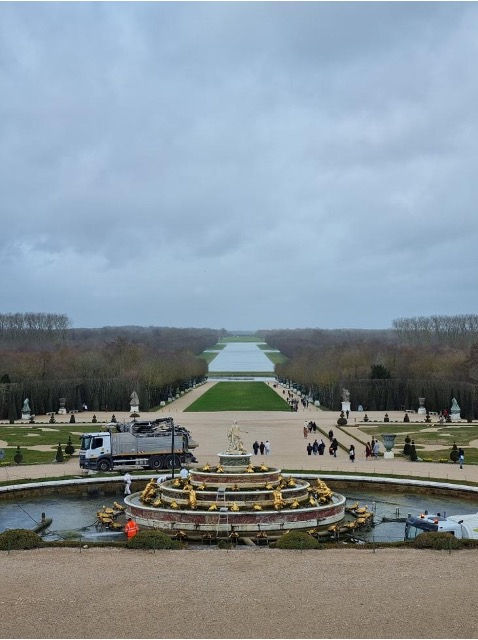
Take, for example, the famous gardens of Chateau Versailles. From the steps, the view across the gardens is magnificent. Hedges on either side gently guide the eye towards the distance; it seems as though this orderly landscape stretches on forever. However, the hedges on the sides are not placed there without reason. They direct your gaze towards the horizon and distort the perspective, so that all distances appear longer than they actually are. Yet these long lines look different up close; there even appear to be entrances within them. A maze opens up, where hedges force (or guide) you to go in a certain direction, or conversely hide a certain direction.
This column has therefore not turned into a paean to the hedge – though, as far as I’m concerned, there are enough qualities here to write a thesis about – and that wasn’t the intention anyway. The questions with which I conclude here are the most important. When we look at the bigger picture, we discover the political side of a landscape feature. The phrase ‘everything is political’ proves its worth here once again, for even something as simple as a hedge is linked to expressions of power and control within the landscape. How do we, as landscape architects and spatial planners, deal with this? How do we – consciously or unconsciously – use design elements to make political choices? When does a hedge lead to curiosity and when to exclusion? And how do we discover for ourselves which core ideas lie behind our choices? Hedges will continue to be important elements within our modern landscapes. It is up to us to guard not only their spatial but also their political impacts.
References
Roeleveld, L. & Gielen, J. (2006). Vlechtheggen van de Achterhoek. Heden, verleden en toekomst van een vergeten landschapselement. https://www.heggen.nu/heggen/_sitefiles/file/DefrapportAchterhoek.pdf
Stevens. (n.d.). Maas hedges, cultural heritage from above along the river Maas in The Netherlands. Adobe Stock. https://stock.adobe.com/nl/images/maas-hedges-cultural-heritage-from-above-along-the-river-maas-in-the-netherlands/750754414?prev_url=detail
Jäger, F. (2023). View from the steps at Chateau Versailles.


Comments